Tuesday, March 13, 2007
Nanak image changed in Califonia

NYT explains it here.
ContraCosta times explains it here.
The state Board of Education voted Thursday to ask a publisher to remove from a seventh-grade history textbook a picture of a Sikh religious leader that many followers said was offensive and inaccurate.
The board agreed to the recommendation from state Department of Education officials and the textbook's publisher, Oxford University Press, to remove the historical portrait of Guru Nanak, the founder of Sikhism, from "An Age of Voyages: 1350-1600."
The controversial image shows Guru Nanak wearing a crown and with a close-cropped beard. The depiction runs contrary to Sikh faith, which requires observant men to wear a turban and not to shave their facial hair.
Guru Nanak also was a man of the people and would not have worn an ornate crown, more than a dozen members of the Sikh faith testified Thursday.
The image is taken from a 19th-century painting made after Muslims ruled India. The publisher used it because it complies with the company's policy of using only historical images in historical texts, said Tom Adams, director of curriculum for the Department of Education.
After Sikhs complained that the picture more closely reflected a Muslim man than a Sikh, Oxford offered to substitute it with an 18th-century portrait showing Guru Nanak with a red hat and trimmed beard. But Sikhs said that picture made their founder look like a Hindu.
The publisher now wants to scrap the picture entirely from the textbook, which was approved for use in California classrooms in 2005. There are about 250,000 Sikhs in California.
Sikh leaders say they want a new, more representative image of Guru Nanak, similar to the ones they place in Sikh temples and in their homes. The publisher has rejected those images as historically inaccurate. No images exist from the founder's lifetime, 1469 to 1538.
the comments section on amardeep's blog bring in the babri masjid / ram janambhomi controvery here. I personally do not see the connection.
Monday, March 12, 2007
Kirpans made in China
Kirpans are now being made in China according to the Times of India.
In the rows of kirpan shops lining the Golden Temple complex, China has made an incursion unknown to most who carry with them one of Sikhism's five symbols. Mintai, a brand from comrade country, is doing particularly well and local kirpan manufacturers are not at all happy about it. Till recently, the annual turnover of Amritsar's kirpan market was estimated at Rs 50 crore. But the hold it had on global kirpan markets seems set to change, thanks to made-in-China entrants.
Shopkeepers said Indians prefer to go for things cheaper and the kirpan is no exception. "A well-crafted medium-sized Chinese kirpan costs Rs 50-100. A similar local kirpan is priced at Rs 150-300. Also, youngsters prefer the foreign variety," one of them said.
Sunday, March 11, 2007
Mira Nair
NYT has an overview of Mira Nair's career in films. Her next project is an adaptation of the book Shantaram.
Beneath its starry high profile, though, “Shantaram” engages issues that have obsessed Ms. Nair throughout her career. For immigrants and their children, what is home? What is family? How do you forge a new cultural identity?
“He is a man who disappears into the fabric of another place,” Ms. Nair said about the Depp character in a recent conversation. Explaining the lure of the novel, she added: “The theme I’m most interested in is, can a foreigner be a native? I’m interested in the seesaw of it, because I’m not sure that in the deepest way that’s possible. Ultimately you have to understand where you came from. Otherwise you’re lost.”
Saturday, March 10, 2007
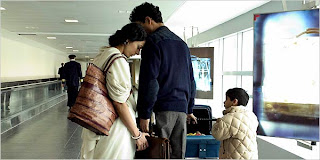
The Namesake


I saw this wonderful movie and recommend it highly. It’s beautiful as it deals with issues of leaving home, bringing up children in a foreign country, dealing with love, loss and finally coming back. The cinematography was mesmerizing, juxtaposing colorful Calcutta with a wintery new York. Irafan Khan and Tabu gave excellent performances. The director Mira Nair, has created an even more emotionally dense movie than Monsoon Wedding.
Sepia Mutiny reviews it here.
“I don’t want to raise him in this lonely country,” says Ashima (Tabu), soon after the birth of Gogol Ganguli in Mira Nair’s new movie The Namesake, opening in a limited release today. Based on the critically acclaimed and commercially successful
novel of the same name by Jhumpa Lahiri, the movie proves to be a remarkably faithful adaptation. Raise him here, of course, she does, but those words remain a rare break in her composure, a heartfelt expression of homesickness and fear.
Friday, March 09, 2007
In the Country of Men Hisham Matar

This is a powerful first book about Qaddafi’s repressive Libya, seen through the eyes of a nine year old boy, Suleiman. The book is focused on the private world of his father, his mother and his friends in the neighborhood. But this world becomes public when his friend Kareem’s father is imprisoned by the government and then hung in a basket ball court among a cheering crowd.
Kamila Shamsie reviews the book in the Guardian here.
And whatever his subject, Matar writes beautifully. In describing the world of seas and mulberries he is a sensualist; when writing of executions and arrests he is a nuanced observer with a gift for conveying both absurdity and raw emotion. His description of a public execution is an exceptional piece of writing - he is not afraid to bring in details that seem entirely incongruous with the setting, yet serve to give it an air of greater verisimilitude. A man trying to resist being taken to the gallows reminds Suleiman of "the way a shy woman would resist her friends' invitation to dance, pulling her shoulders up to her ears and waving her index finger nervously in front of her mouth". The scene is by turns absurd, painful and terrifying - and, with consummate confidence, at the crucial moment of the hanging Matar is able to step back from the detailed descriptions and evocative imagery to tell us, simply and chillingly: "Everybody seemed happy."
The writing is emotionally honest, with Suleiman questioning his own actions often.
I.H.T. has a review by Lorraine Adams
here.
The boy interrogates himself after each episode, weak with shame. But then morning comes, what he experienced recedes, and its lessons fail to take hold. Gradually, we begin to apprehend the ways in which any despotic system is like any boy's inner life. Short-lived in their affections, easily offended, impressed with showboating stadiums of cheering automatons, blindly vicious, the boy and the system embody a topsy-turvy puerility. As in Orwell's famous formulation — "war is peace, freedom is slavery, ignorance is strength" — the world has lost its definitions, or, in Matar's formulation, it has yet to learn them.
Ultimately, this is a novel most concerned with relationships between people - friends, spouses, comrades and, particularly, parents and their children. Matar movingly charts the ways in which love endures in situations of great repression, but also shows how repression threatens everything, even love, putting relationships under a strain that can be unendurable.
Subscribe to:
Posts (Atom)
-
I suggest that every one of you should try - oh! not for long, just for one hour a day - to say nothing but the absolutely indispensable wor...
-
Who and What Is Buddha, Really? What's Your Reaction: Amazing Inspiring Funny Scary Hot Crazy Important Weird Read More: Buddha , Budd...
-
Sivananda's Message of the Day for Wednesday, April 14, 2010 Kindness does not consist in gifts, but in gentleness and generosity. -- S...