Saturday, May 02, 2009

Somaly Mam


Somaly Mam and Cambodia's Khmer Rouge regime were born around the same time — when the U.S. began secretly carpet bombing her country. The bombed villages became fertile ground for the Khmer Rouge's growth and Pol Pot's revolution.

By the time Mam was 5, the Khmer Rouge controlled Cambodia and had proceeded to kill 1.5 million people as Pol Pot implemented his radical form of communism. Torture, executions and forced labor were widespread. Families fled for safety, and massive internal displacement decimated Cambodian society in the years that followed.

Against this backdrop, 12-year-old Mam was sold into sexual slavery by a man who posed as her grandfather. She eventually ended up in a Phnom Penh brothel, beginning a decade of horrific rape and torture. She describes this period of her life simply: "I was dead. I had no affection for anyone."

Terror is the weapon of choice for those who hold women in sexual bondage. They depend on their victims' being frozen with fear. Traffickers hope that with enough pain and degradation, women will simply accept their fate as inescapable.

But Mam was able to escape. With the help of an aid worker from France, she fled Cambodia in 1993.

The fact that she escaped makes her unique, but what makes her truly extraordinary is that she went back. While, understandably, most people would spend the rest of their lives quietly recovering from their wounds, Mam decided to confront the system that continues to victimize Cambodian girls.

In 1996, Mam created a nonprofit organization called AFESIP (Agir pour les Femmes en Situation Précaire, or Acting for Women in Distressing Circumstances) that works with local law enforcement to raid brothels and reintegrate the trafficked women into society. It is estimated that between 1.2 million and 2 million people are currently being held as sex slaves around the world. Mam, now 38 or 39 (she does not know her birthday), has established a model for addressing this issue and has already helped more than 4,000 women escape the brothels.

She has paid a terrible personal price for doing so, enduring death threats and assaults. In an effort to deter her work, brothel owners even kidnapped, drugged and raped Mam's then 14-year-old daughter in 2006.

Most people would have walked away. Mam continues to fight back so that others can be spared the pain she once suffered.

Jolie, an Oscar-winning actress, is a goodwill ambassador for the U.N. High Commission for Refugees and co-chair of the Jolie-Pitt Foundation

Suraya Pakzad


Suraya Pakzad knows well that death threats in Afghanistan must never be taken lightly. Especially those against high-profile, outspoken women like her, for whom such threats are an occupational hazard. In recent years, extremists have assassinated Malalai Kakar, the country's most prominent policewoman; Safia Ama Jan, director of the Ministry of Women's Affairs in Kandahar; and journalist Zakia Zaki. I cannot imagine the reserves of courage that Pakzad, 38, taps into every morning when she steps out the door, knowing it may be for the last time.

But for several years now, at great risk to herself, this is just what she has done. It is difficult to name a more committed advocate for women's rights in Afghanistan. A recipient of the 2008 International Women of Courage Award, Pakzad is the founder of the Voice of Women Organization, committed to providing Afghan women with shelter, counseling and job training. Her shelters give abused women safe haven, legal services and long-term protection. She has worked tirelessly to raise awareness about gender-based violence that victimizes Afghan women.

Pakzad knows that any future success for Afghanistan depends greatly on the full, unimpeded participation of its women as contributing, productive members of society. In 1926, then Queen Soraya said famously, "Do not think, however, that our nation needs only men to serve it. Women should also take their part, as women did in the early years of Islam. The valuable services rendered by women are recounted throughout history. And from their examples, we learn that we must all contribute toward a development of our nation." This is what Pakzad believes. This is what she fights for. And it is — and this, however unpleasant, must be said — what she may die for.

Hosseini is the author of the novel Thousand Splendid Suns

Sunday, April 26, 2009

Why torture is wrong, and the people who love them


I saw this play at the public theatre today and found it relevant and distressing at the same time.

Don’t feel guilty about laughing so hard at “Why Torture Is Wrong, and the People Who Love Them,” Christopher Durang’s hilarious and disturbing new comedy about all-American violence. Though it tackles and practically tickles to death subjects that are sensitive to the point of rawness just now, the production, which opened on Monday night at the Public Theater, has a healthier heart and conscience than many a more pious play.


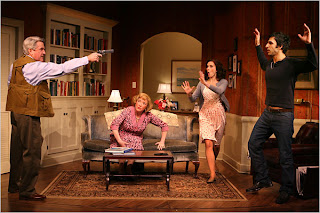
"Why Torture Is Wrong, and the People Who Love Them," with Laura Benanti and Amir Arison, opened on Monday at the Public Theater.
It’s just that Mr. Durang chooses to wear his morality not as a minister’s black robe but as a jester’s crazy motley. There are occasions when this is perfectly correct attire for playwrights of good faith, especially when they’re visiting matters that have started to seem too serious to be taken seriously. Like guns in the hands of angry and irrational people, and torture as a first-resort means of interrogation, and raging paranoia as an accepted worldview.

Scary is funny this season in the New York theater. Mr. Durang’s work (henceforth to be referred to as “Torture,” though watching it is not) is the latest offering in a trifecta of aggressively dark comedies that have opened in recent weeks, shows that draw gasping laughs from grim topics.

Yasmina Reza’s “God of Carnage” considers the loneliness in the everyman-for-himself savagery that lurks beneath civilized relationships, while the Broadway revival of Eugène Ionesco’s “Exit the King” is about people’s refusal to face their own deaths.

“Torture,” though, moves beyond brooding abstractions to the specifics of its title activity — with graphic onstage demonstrations — and of the idea of trigger-happiness as a conditioned reflex in masculine culture. Given recent accounts of prisoners tortured in the C.I.A. detention program and the mass killing by a gunman at an immigration services center in Binghamton, N.Y., you might think no sensible theatergoer would want to attend a play in which a young man is tied to a chair to be beaten bloody and a leading character points a rifle at the audience, musing on spraying it with bullets.

Yet “Torture,” directed with just the right balance of crudeness and finesse by Nicholas Martin, turns such scenes into occasions for one of the most releasing forms of laughter: the kind that encourages the spewing of the anger, fear and helpless indignation that build up in anyone who still reads or watches serious world news.

Little spurts of such laughter are provided by mock-news shows and sketch satire on television. But Mr. Durang, bless his heart, believes that no other art form can offer the communal catharsis — and consolation — that theater does, a point he makes quite directly (between bouts of violence) in “Torture.”

This is the playwright, after all, who turned his own unhappy childhood into works (“Baby With the Bathwater,” “The Marriage of Bette and Boo”) that became templates for that increasingly fashionable genre, the comedy of domestic dysfunction. With the blissfully grisly “Betty’s Summer Vacation” (1999, also directed by Mr. Martin), he broadened his focus to explore (and condemn) the American appetite for entertainment at all costs.

Like “Betty’s” (which until now I regarded as Mr. Durang’s funniest play), “Torture” places at its center a sensible-seeming young woman to whom the sort of things happen that more typically befall virginal heroines of splatter movies. In the play’s first scene the hopefully named Felicity (Laura Benanti, in a lovely anchoring performance) wakes up in a cheap hotel room to learn that she has married a quick-tempered chap named Zamir (Amir Arison), who says he is Irish and is given to pronouncements like, “It’s a flaw in my character, but all the women in my family are dead.”

You’re no doubt familiar with this situation. (I mean, from movies and television, not from personal experience.) And for the play’s first few minutes, I feared it might turn into a morning-after sitcom. Then again, there are all those unsettling references to Zamir’s predilection for violence, date-rape drugs and mysterious midnight errands involving money hidden under rocks.

Imagine the relief when the action switches to the cozy New Jersey living room of Felicity’s mother, Luella (Kristine Nielsen), first seen raptly contemplating a flower arrangement. Of course that relief evaporates when Felicity’s dad, Leonard (Richard Poe, deliciously channeling George C. Scott in highest dudgeon), strides in to explain that that burning smell is not French toast, but some squirrels he incinerated with a napalm blaster. He then puts a gun to the head of Zamir, who responds by threatening to use his cellphone to make the whole house explode.

That takes us only to Scene 2, but I won’t describe the plot any further. Suffice it to say that things get really crazy from then on, with references to a shadow government and ominous Supreme Court rulings; a description of the incapacitated Terri Schiavo as the ideal wife; a prim woman in a Republican red suit walking with her panties around her ankles; and people using code names taken from Looney Toons characters. I can honestly say I know of no other show in which a man (played by a priceless David Aaron Baker) gleefully yells, “Bweak da fingah. Bweak da fingah,” in the voice of Elmer Fudd.

This is all carried out in the highest, giddiest style imaginable, what with David Korins’s marvelous revolving set functioning as a whirligig fun house for this fang-toothed farce. (Best set-inspired moment: when Felicity discovers her father’s secret sanctuary.)

And Mr. Martin has drawn precise, Marx Brothers-esque anarchy from his spot-on ensemble, which also includes John Pankow (as a pornography-making minister), Audrie Neenan (as the woman with the panty problem) and a multifarious Mr. Baker.

But within the theatrical fun and games is the subliminal, creepy buzz generated by an addiction to violence that transcends cultures but is apparently coded in the male chromosome. Mr. Durang lets neither American nor Arabic men off the hook for their bone-breaking problem-solving methods and their treatment of their women. No wonder that Luella — played by Ms. Nielsen, a longtime Durang muse, with the marvelously addled air of a thwarted actress in retreat from reality — goes to the theater in hopes of learning “what normal is.”

Felicity says she has no use for the theater, which after all has become so expensive and so darn Anglo-Irish. (There are jokes about people committing suicide during plays by Tom Stoppard and Brian Friel.) But Felicity is oh, so wrong. The theater is what lets a playwright like Mr. Durang heighten absurd, vicious human behavior into detoxifying Absurdity and — for a few silly, happy moments — create an artificial world in which all wrongs are righted, and mutually respectful couples go dancing in the dark without crashing.

WHY TORTURE IS WRONG, AND THE PEOPLE WHO LOVE THEM

By Christopher Durang; directed by Nicholas Martin; sets by David Korins; costumes by Gabriel Berry; lighting by Ben Stanton; music by Mark Bennett; sound by Drew Levy; production stage manager, Stephen M. Kaus; general manager, Andrea Nellis; associate artistic director, Mandy Hackett; associate producer, Jenny Gersten; director of production, Ruth E. Sternberg. Presented by the Public Theater, Oskar Eustis, artistic director; Andrew D. Hamingson, executive director. At the Public Theater, 425 Lafayette Street, at Astor Place, East Village; (212) 967-7555. Through April 26. Running time: 2 hours 15 minutes.

WITH: Amir Arison (Zamir), David Aaron Baker (Voice), Laura Benanti (Felicity), Audrie Neenan (Hildegarde), Kristine Nielsen (Luella), John Pankow (Reverend Mike) and Richard Poe (Leonard).


Here is another review.
During the last couple of weeks, the actress Kristine Nielsen has noticed a change in the audiences at Christopher Durang’s satirical new play, “Why Torture Is Wrong, and the People Who Love Them,” especially in the second act, when blood appears on the T-shirt of a suspected terrorist and on the blouse of one of his comically daffy interrogators.

In a relatively rare confluence of theater and politics, the critically lauded production of “Torture” opened nine days before the Justice Department, on April 15, made public four memos that described brutal interrogation techniques authorized by the Bush administration. The furor over those methods, which included waterboarding, has only intensified during the run of the play (which ends on May 10), as President Obama, former Vice President Dick Cheney and others in Washington have debated whether it is necessary to hold public hearings and possibly prosecute those involved in the interrogations.

For Mr. Durang, who has been writing satires of American society for three decades — he took on religion in “Sister Mary Ignatius Explains It All for You” in 1979 and suicide in “Miss Witherspoon” in 2005 — the unusually timely resonance of his latest work has come as a kind of relief. He has been so angry at the Bush administration for so long, he said, that he is thrilled to see the issue of torture in the spotlight, onstage and off.

“I myself feel that the play is a catharsis, a comic catharsis, for the last eight years,” Mr. Durang said in an interview this week. “What’s particularly strange and unusual, though, is the play running when all of a sudden all these torture memos are released and discussed. It feels like I wrote some of these scenes yesterday.”

Mr. Durang did not set out to write about torture. In 2007, as an exercise for a class he teaches at Juilliard, he wrote what would become the first scene of the play: a woman named Felicity (now played by Laura Benanti) wakes up in bed with a man named Zamir (Amir Arison), whom she doesn’t remember, yet whom she married the night before (and who, in addition, drops hints that he might be a terrorist). In the next scene Felicity introduces Zamir to her parents, Luella and Leonard (Richard Poe). Tensions soon flare between Zamir and Leonard, who is a deeply emotional political conservative.

“At first my thought was to get into the red state-blue state stuff between these two men, who are both so hot-headed and have strongly held feelings,” Mr. Durang said.

“But as I was writing — and I don’t write with an outline — I had this idea of Leonard offstage in a private room that supposedly contains his ‘butterfly collection,’ a room he doesn’t let anyone else see, and then I started thinking about secrets and deception, and my thoughts about the play started to shift,” he continued.

The interview with Mr. Durang was conducted in the so-called butterfly room on the stage of the Public — a room that, as the play reveals, is actually an attic torture chamber full of guns, swords and grenades, and where Leonard and his ally Hildegarde (Audrie Neenan) end up interrogating Zamir.

Before that scene, Leonard and Hildegarde huddle in the butterfly room to discuss how they will handle Zamir, an exchange that Mr. Durang says was inspired by a now-infamous interrogation memo written by John Yoo, an official in the Justice Department during the Bush presidency.

LEONARD: We’ll stick to John Yoo’s torture definition very closely.

HILDEGARDE: I’ve forgotten what that is.

LEONARD: How could you forget such a significant thing? John Yoo from the Justice Department wrote a torture memo saying that it isn’t torture unless it causes organ failure. And even if it does that, as long as the president says the words “war on terror,” it’s A-O.K.

HILDEGARDE: Oh that’s right. He’s such a brilliant lawyer, John Yoo, and how I love the Federalist Society.

The archness of this dialogue — and the absurdity of other scenes featuring Mr. Durang’s two torturers and their role in a “shadow government” — closely reflect the playwright’s real political sensibilities and suspicions. In an hourlong interview he railed against Mr. Bush, Mr. Cheney, Mr. Yoo and others at great length, though none of his characters were based on them.

“Once I came upon the shadow government idea for the play, I really did think of Cheney, because he was fairly secretive,” Mr. Durang said. “But I also was choosing not to base the people on Bush and Cheney, because I thought that would tie me down too much.”

Striking a balance between the satire in Mr. Durang’s play and the gravity of its subject matter fell chiefly to the production’s director, Nicholas Martin. He said that he and his actors and designers had lengthy conversations about “treading a very careful line to maintain the play’s humor” while also using clothing, props, lighting and — in selected ways — fake blood.

“One particularly important point was about which clothing garments would be bloody, and how bloody they would be,” Mr. Martin said. “I initially thought there should be less blood on the clothes, but that really would have diluted the truth of what was happening to Zamir. And when the father produces a baggie containing three human fingers and an ear, well — we knew we couldn’t stint on the blood.”

The play’s unusual ending — in which Felicity stops the action onstage and suggests changing all that has come before, because the torture of Zamir pains her — was meant by Mr. Durang to comfort the audience. But Oskar Eustis, the artistic director of the Public, offered another interpretation.

“Someone said to me that the play’s ending captures our desire to undo the last eight years,” Mr. Eustis said. “I do think Chris was tapping into a longing in this country that is very deep to redo things, to say, ‘Torture is not who we are.’ ”

New York Magazine- Rich People Things

Chris Lehmann
writes about the social, class and power that New York Magazine represents. I find the magazine vacuous, gossipy and centered in downtown Manhattan reality.

My ill-starred tenure at New York magazine was, among other things, a crash course in the staggering unselfawareness of Manhattan class privilege. Sure, there was the magazine’s adoring, casual fascination with the “money culture”—a term deployed in editorial meetings without the faintest whiff of disapproval or critical distance. But more than that, there was the sashaying mood of preppy smugness that permeated nearly every interaction among the magazine’s editorial directorate—as when one majordomo tried to make awkward small talk with me by asking what it was like attending an urban public high school, or when another scion of the power elite would blithely take the credit for other people’s work and comically strategize to be seated prominently at the National Magazine Awards luncheon.

Since decamping from that scheming hovel of status, I’ve tried to write it off as a ludicrous resume misfire, gnashing my teeth at the odd “Look Book” entry or wildly off-key Kurt Andersen column. But as the “money culture” collapses into a smoldering ruin, Adam Moss’s weekly catalog of plutocratic self-regard has become harder and harder to ignore. Week in and week out, New York sends out panicked instructions for scraping by when the cash spigots have dried up, and dispatches survival strategies for the equally deranging state of affairs where no one believes that the social hierarchies founded on the fancies of the paper economy command awed reverence—or indeed, should be permitted to continue at all. If conservative Middle America greets bailouts and the specter of slight marginal tax hikes kicking in two years from now with Tea Parties, New York has been hosting its own months-long encounter group for the super-rich laid low—the revolt of the “are nots,” if you will, protesting a world where they are neither especially elite nor powerful.

And like any encounter group leader, the magazine’s editorship traffics in a comforting jargon—a sort of class privilege all its own. The operative terms in its reckoning with the fallout from the last decade’s pillaging always describe subjective moods and feelings, not actual privation or suffering. In place of mass layoffs, repossessions or hijacked pensions, there is diffuse “envy,” “resentment” and “rage”—moods that with the proper forensic understanding can somehow be channeled, one senses, back into reassuring class deference, in much the same way that a clumsy faux-pas could be passed over at the court of Versailles. You will recall that even New York’s arch takedown of the upstart social arbiters of the blogging world was given the nonsensical headline “The Rage of the Creative Underclass”—masking the magazine’s own palpable class-based derision in the sociological feelspeak of the seminar room. (I have no doubt that, should any senior big thinker at the magazine stumble on these ruminations, I’ll be dissected in much the same fashion—I went to a public high school, after all.)

And this week’s special cover package on the “Rage of the Rich” neatly distills all these editorial impulses into one handy ur-Text. Gabriel Sherman’s lead piece, “The Wail of the 1%,” (subtitled—wait for it—“As the privileged class loses its privileges, a collective moan rises from the canyons of Wall Street”) recounts the raw anger of today’s cohort of investment honchos deprived of what they see as their hard-won fair wages. Sherman may claim possession of the piece’s byline (a distinction that may prove to have the long-term value of an AIG stock bonus circa 2009), but the lavishly emotivist text bears all the thumbprints of the magazine’s money-obsessed braintrust. Is there the tone of puzzled hurt? Oh yes, there is: The celebrated resignation letter penned by AIG commodities trader Jake DeSantis and later run as a New York Times op-ed was “passionate and wounded,” the piece marvels. Yes, its language was also “oddly out of touch with ordinary Americans”—but look at its therapeutic value! DeSantis’ letter “put a human face on Wall Street’s anger”—something that precisely no American not named Rick Santelli was clamoring for, but let that pass. There is, after all, a larger moral here: “In a witch hunt, the witches have feelings, too. As populist rage has erupted around the country, stoked by canny politicians, an opposite rage has built on Wall Street and other arenas where the wealthy hold sway” (and yes, I could not help but picture a Tuesday morning New York magazine edit meeting here; my own therapeutic progress has been, alas, more halting than I might have hoped).

In any event, we are now penetrating to the intolerable inner conflict at the heart of the pathology: Wall Street rage, in its “expression is more furtive and it’s often mixed with a kind of sublimated shame,” Doktor Sherman explains, “but it can be every bit as vitrioloic.” Yes, our subjects are “difficult” candidates for sympathy, he continues elsewhere, “but you can understand their shock: Their world has been turned on its head. After years of enjoying favorable tax rates, they are facing an administration that wants to redistribute their wealth”—it never appearing to occur to Sherman’s sources, Sherman himself, or least of all his editors that these favorable tax rates are themselves mechanisms for redistributing wealth, and making it “theirs” in the first place. But again, let us not be detained by policy particulars—on to the feelings! “No one know what Wall Street will look like in a few years,” Sherman darkly incants, as though the head of the US Treasury Department were not an investor-appeasing former chairman of the New York Fed. And how, please, are the raging bankers reacting? “They are anxious, and their anxiety is making them mad.”

Sherman’s piece is generously bedecked with self-pitying anonymous quotes from indignant traders and bankers to bear out this clinical view. (They are also, one surmises, the link bait that has made Sherman’s story the most frequently emailed on the magazine’s site; it turns out that the preppy magazine class, no less than “canny politicians” can make with the strategically leveraged “populist rage.”) But really, these clueless whingeing sentiments are the pulpy B-roll footage here; yes, these are hypocrites who seem to have forgotten that their “industry” owes its continued existence to a titanic government bailout; yes, it’s easy to hate on the going-Galt rhetoric of Sherman’s nameless Spartacuses of the are-not revolt (“JP Morgan and all these guys should go on strike,” one fumes, “see what happens to the country without Wall Street”; “The government wants me to be a slave,” another laments, contemplating the horror of the return of Clinton-era tax rates).

But such cheap Schadenfreude misses the main point, which Sherman spells out with admirable, if analytically bankrupt, clarity. The secret conviction coursing through Wall Strteet’s caverns is this, he writes: “Those who select careers in finance play an exceptional role in our society. They distribute capital to where it’s most effective, and by some Ayn Rand-ian logic, the virtue of efficient markets distributing capital to where it is most needed justifies extreme salaries—these are the wages of the meritocracy.”

Now, the widespread abuse of the term “meritocracy”—a term of satire coined in a novel by a British socialist—is a sermon for another occasion. But consider the plain wrongness of the surrounding fluff: By no measure, was capital distributed “efficiently”—let alone to places “where it was most effective” in the investor-invented calamity known as the mortgage meltdown. What’s more, the question of where capital “is most needed” is inherently a political one. Post-Katrina New Orleans certainly could make do with a whole lot of efficiently delivered private capital, but somehow it was never kicked up, even in the headiest days of the housing bubble. Likewise, the “exceptional role” played by the nation’s princeling capital-herders, as the piece goes on to ploddingly rehearse, consists largely of emailing to their foreign-market counterparts at odd off-work hours; what they’re really up in arms about—with their New York magazine enablers feverishly goading them on—is seeing their social status in free-fall. “No offense to Middle America,” one of these firebreathing social prophets emails, “but if someone went to Columbia or Wharton, [even if] their company is a fumbling, mismanaged bank, why should they all of a sudden be paid the same as the guy down the block who delivers restaurant supplies for Sysco out of a huge, shiny truck?”

Well, no offense taken here, pal! It’s all just part of the process, after all: “In this conversation about money, there’s a lot to work through,” Sherman counsels in the piece’s wind-up. “Just months ago, the masses kept what anger they had to themselves, and the bankers were close-lipped about what they thought they were owed by society. There wasn’t much of a dialogue about the haves and have-nots and who was entitled to what. For the privileged, it was a lot more comfortable when things remained unspoken. Almost more than the loss of money, they are concerned with the loss of status and pride.”

Well, of course they are—for the simple reason that nothing else really exists in the Mossian wonderland of New York money. It’s not as though the financial industry lobbied for decades to repeal consumer bankruptcy protections—or mounted a concerted political donorship campaign to secure the 1999 repeal of the Glass-Steagall act, which oversaw the disastrous conversion of non-bank entities like AIG into bond trading enterprises in the first place. It’s not as though the first Bush appointee to head the SEC, William Donaldson, was cashiered in favor of corporate toady Christopher Cox because precisely these same market elites demanded Donaldson’s head for the sin of proposing more regulation of financial markets.

No, in New York magazine land, there are simply organic social hierarchies, and the way that the titans who once lorded over them feel about their sundered patrimony. There is a “dialogue” to be had about “the haves and have nots” and a “conversation about money” to work though—precisely because these are the preferred narcissistic entertainments of people who have had never had to worry about money at anything other than a conversational level. Conversations involve no transfer of power, after all, and dialogues are not pitched at demonstrating the social utility of one conversation partner’s core assumptions about “who was entitled to what.” So long as no one is setting a viable industrial policy, redressing enormous deficits in education, urban development and universal health coverage for the nation’s vast majority of non-Wharton graduates, conversation is just that—talk, and talk that overwhelmingly serves the interests of the people who have muscled their way into positions of social predation.

But you know what? Go ahead and talk amongst yourselves, masters of the universe—and let your therapists-manqué at New York transcribe your every mawkishly aggrieved word. Every phony social revolution needs its Joe the Plumber, after all—and Messrs. Moss, Sherman et al fit the bill nicely. Watch the decibel level, though—it turns out that a lot of people went to public

Juan Cole writes an intelligent response to the situation in Pakistan

Juan Cole writes this on his blog...

Pakistan Crisis and Social Statistics

Readers have written me asking what I think of the rash of almost apocalyptic pronouncements on the security situation in Pakistan issuing from the New York Times, The Telegraph, and Secretary of State Hillary Clinton in recent days.

And Stephen Walt also is asking why there are such varying assessments of Pakistan's security prospects. He suggests that one problem is the difficulty of predicting a revolutionary situation. But Pakistan just had a revolution against the military dictatorship! The polling, the behavior in the voting booth, the history of political geography, aren't these data relevant to the issue? Why does no one instance them?

As I have said before, although the rise of the Pakistani Taliban in the Pushtun areas and in some districts of Punjab is worrisome, the cosmic level of concern being expressed makes no sense to me. Some 55 percent of Pakistanis are Punjabi, and with the exception of some northern hardscrabble areas, I can't see any evidence that the vast majority of them has the slightest interest in Talibanism. Most are religious traditionalists, Sufis, Shiites, Sufi-Shiites, or urban modernists. At the federal level, they mainly voted in February 2008 for the Pakistan People's Party or the Muslim League, neither of them fundamentalist. The issue that excercised them most powerfully recently was the need to reinstate the civilian Supreme Court justices dismissed by a military dictatorship, who preside over a largely secular legal system.

Another major province is Sindh, with nearly 50 mn. of Pakistan's 165 mn. population. It is divided between Urdu-speakers and the largely rural Sindhis who are religious traditionalists, many of the anti-Taliban Barelvi school. They voted overwhelmingly for the centrist, mostly secular Pakistan People's Party in the recent parliamentary elections. Then there are the Urdu-speakers originally from India who mostly live in Karachi and a few other cities. In the past couple of decades the Urdu-speakers have tended to vote for the secular MQM party.

Residents of Sindh and Punjab constitute some 85% of Pakistan's population, and while these provinces have some Muslim extremists, they are a small fringe there.

Pakistan has a professional bureaucracy. It has doubled its literacy rate in the past three decades. Rural electrification has increased enormously. The urban middle class has doubled since 2000. The country has many, many problems, but it is hardly the Somalia some observers seem to imagine.

Opinion polling shows that even before the rounds of violence of the past two years, most Pakistanis rejected Muslim radicalism and violence. The stock of the Taliban and Al-Qaeda plummeted after the assassination of Benazir Bhutto.

The Pakistani Taliban are largely a phenomenon of the Federally Administered Tribal Areas west of the North-West Frontier Province, and of a few districts within the NWFP itself. These are largely Pushtun ethnically. The NYT's breathless observation that there are Taliban a hundred miles from Islamabad doesn't actually tell us very much, since Islamabad is geographically close to the Pushtun regions without that implying that Pushtuns dominate or could dominate it. It is like saying that Lynchburg, Va., is close to Washington DC and thereby implying that Jerry Falwell's movement is about to take over the latter.

The Pakistani Taliban amount to a few thousand fighters who lack tanks, armored vehicles, and an air force.

The Pakistani military is the world's sixth largest, with 550,000 active duty troops and is well equipped and well-trained. It in the past has acquitted itself well against India, a country ten times Pakistan's size population-wise. It is the backbone of the country, and has excellent command and control, never having suffered an internal mutiny of any significance.

So what is being alleged? That some rural Pushtun tribesmen turned Taliban are about to sweep into Islamabad and overthrow the government of Pakistan? Frankly ridiculous. Wouldn't the government bring some tank formations up from the Indian border and stop them?

Or is it being alleged that the Pakistani army won't fight the Taliban? But then explain the long and destructive Bajaur campaign.

Or is the fear that some junior officers in the army are more or less Taliban and that they might make a coup? But the Pakistani military has typically sought a US alliance after every coup it has made. Who would support Talibanized officers? Not China, not the US, the major patrons of Islamabad.

If that is the fear, in any case, then the US should strengthen the civilian, elected government, which was installed against US wishes by a popular movement during the past two years. The officers should be strictly instructed that they are to stay in their barracks.

What I see is a Washington that is uncomfortable with anything like democracy and civilian rule in Pakistan; which seems not to realize that the Pakistani Taliban are a small, poorly armed fringe of Pushtuns, who are a minority; and I suspect US policy-makers of secretly desiring to find some pretext for removing Pakistan's nuclear capacity.

All the talk about the Pakistani government falling within 6 months, or of a Taliban takeover, flies in the face of everything we know about the character of Pakistani politics and institutions during the past two years.

My guess is that the alarmism is also being promoted from within Pakistan by Pervez Musharraf, who wants to make another military coup; and by civilian politicians in Islamabad, who want to extract more money from the US to fight the Taliban that they are secretly also bribing to attack Afghanistan.

Advice to Obama: Pakistan is being configured for you in ways that benefit some narrow sectional interests. Caveat emptor.

Saturday, April 25, 2009

Mallika Sarabai for the Lok Sabha


Here is her Manifesto. I wish she wins. Gujarat needs another voice, a saner voice than the fascist Narinder Modi.I recently saw Firaaq, directed by the brilliant Nandita Das. The movie is depressing but honest about what happened in Gujarat after the 2002 riots. And how people react to "the other".

Internationally acclaimed classical dancer Mallika Sarabhai is taking on India's main opposition leader LK Advani of the Bharatiya Janata Party in the general elections from Gujarat. The BBC's Soutik Biswas hits the campaign trail with the feisty artiste in Gandhinagar.

A little over a fortnight ago, Mallika Sarabhai woke early one weekday morning and heard what she called an "inner voice".

Over the weekend, a group of NGOs had approached her, promising to back her if she contested the general elections as an independent candidate.

The proposal left the busy Ms Sarabhai in a spin: she had been in the middle of recording a TV quiz involving schoolchildren in western Gujarat state, where she lives and works.

She mulled over the proposal; such invitations were not new to her. Since 1984, she says, the Congress party has approached her at every election to contest its ticket.

"I always turned them down, saying that I was not ready," she says. "And I have never considered contesting an election as an independent because I knew independents have very little chance in our political system."


Ms Sarabhai says politics has reached its nadir in India

But this time, the "inner voice" intervened.

"The time is now, the voice told me," says Ms Sarabhai.

This is how she finds herself in the maelstrom of an Indian election. This is also how she finds herself pitted against the leader of the main opposition BJP and prime ministerial candidate LK Advani in the Gandhinagar constituency.

"This is how," says Ms Sarabhai, "within 15 days my life has changed. I have been doing 16-hour workdays and already have met over 100,000 people in my campaign."

We are sitting in her tasteful red-brick office near a thriving performing arts academy that India's most celebrated independent politician has built on the banks of the Sabarmati, which flows through the city of Ahmedabad.

"I am not ruling out a win. I might get one vote or I may get 500,000 votes. But I am going to fight. Politics has reached its nadir in India," she says, punching away furiously on her BlackBerry.

As a battle between political rivals, the fight for Gandhinagar cannot be more unequal - the Indian version of David and Goliath.

Mr Advani is the 81-year-old veteran of Indian politics. He is the shadow prime minister, leads a conservative Hindu nationalist party and is backed by powerful and rich party machinery.


The challenge is formidable - LK Advani is a powerhouse

Ms Sarabhai, 54, is a political greenhorn with no party but a lot of energy and an enviable reputation.

She is India's best known dancer-actor-activist, has an MBA and doctorate from the country's best business school and is the daughter of a renowned space scientist.

She is also the scion of one of the country's most progressive business families, a feisty liberal and a divorced mother of two.

Ms Sarabhai is also putting up a spirited fight with her army of plucky young volunteers.

They sing songs, dance, perform theatre on the streets and use their formidable online networking skills to spread the campaign far and wide.

There are satirical digs at her rival's second name - Advani, in Gujarati, means "don't touch".

"I have no money to fight an election," she says. "But we are managing."

Youthful energy

Ms Sarabhai's snazzy election site solicits donations and publishes data on the contributions - more than 600,000 rupees ($12,000) have poured in in a fortnight, the site says.


Her supporters say she is a symbol for change

There is no lack of pluck. A trenchant critic of the BJP government's "inaction" during the 2002 riots in Gujarat, she was hounded by the state government, who slapped charges of "human trafficking" on her only to drop them after a national outrage.

Now she has challenged Mr Advani to a public debate. For the most part, Mr Advani and his party have ignored her.

But Ms Sarabhai is a consummate performer and communicator: on her walkabouts, she works the crowds, breaking into song and dance, in city neighbourhoods and shantytowns alike.

"She is a symbol of change," says Wilson Battu, a New York-based retail management consultant and friend, who says he helped in the Obama campaign and is now assisting Ms Sarabhai.

The Sarabhai campaign has an element of the hip - a youthful energy not usually associated with Indian politics.

Many of the young volunteers who have signed up for her - numbering about 700 - talk about tips they picked up from the Obama campaign.

What development is the government talking about? Whose development?"

Mallika Sarabhai

Catchy songs specially composed for the campaign blare out of speakers when she hits the road.

A campaign film and a mobile video van to ferry her message around the countryside is in the works.

Volunteers are turned out in the campaign tricolour - red, white and purple - or wearing scarves. The campaign is on Facebook and Twitter.

In the morning, she is working middle-class households in the city in what she calls "network meetings".

"What would we prefer - a clean society or a filthy one?" she asks a group of local denizens who have gathered in a musty room.

When dusk falls and the heat abates, she travels across her sprawling constituency, home to 1.5 million voters and, among other things, the factory making the Nano, the world's cheapest car.

Ms Sarabhai says her campaign has been a learning experience - of what she calls "exploitative and unequal" conditions in what is hyped as India's most economically developed state.

She says she has met struggling government health workers with earnings that violate the state's own minimum wage, and a Muslim driver who wept after she offered him a job because he had been "rejected 40 times because of his religion".

"And 70% of the villages and slums I have visited in my constituency have no toilets. What development is the government talking about? Whose development?"

Campaign badges and stickers show a beaming Ms Sarabhai asking: "Won't you support me? Won't you vote for me."

Three weeks from now, she - and her countless admirers - will know. But even if she loses, Mallika Sarabhai promises to be back - she swears she is not going to be an accidental politician.

This from the BBC.

Friday, April 24, 2009

Happy George Day

Juan Cole writes about George today celebrated in Barcelona, where women give men books and men give women flowers.

Friday, April 24, 2009
A Modest Proposal: George's Day and Saving Bookstores (and not bad for Florists either)

There is a delightful custom in Barcelona. On April 23, St. George's Day, men give their girlfriends or wives a rose. And the women give their male beloved a book. The gift of the book is said to have been initiated in 1926 as a commemoration of Cervantes, the author of Don Quixote

The rose is more traditional. It is said that after St. George killed the dragon to save the maiden, a droplet of its blood sprouted into a rose.

Perhaps under Catalonian influence, April 23 has already been adopted by UNESCO as the International Day of the Book. However, I don't think very many people know about this day.

The advantage of the way the Barcelonans do it is that it ties book-giving to individual romance, and so makes it universal. Obviously the precise Catalonian custom, however quaint and colorful, is pretty sexist and needs updating. But if it is altered slightly, I think we have here a commemoration worth widely adopting.

I propose that whoever loves someone else romantically of any sex give the loved one both a book and a rose for George's Day.


If we do it that way, I think George's Day could be promulgated successfully as a day internationally observed by individuals, just as Valentine's Day has become.

April 23 has the advantage of falling at a time of year when there is little to drive customers to bookstores. Moreover, despite UNESCO's effort, there is no popularly recognized special day for book-buying. One can give a book on lots of occasions, but it is just one possible gift among many. Having a special day on which only a book will do as a gift would be a great good thing. And, of course, buying someone a Kindle file would also work.

It is true that St. George is a Catholic saint and so on the surface not suited to universal commemoration. But I know of nothing objectionable about him, and the main legend associated with him is that of killing the dragon. That is of course a mythic deed common in world mythology-- Indra and Vrta, Faridun and Zohak, Thor and the Midgaard serpent. Killing the dragon of ignorance on behalf of the Book is a universal.

Besides, in the US we don't have a problem widely commemorating St. Valentine's Day. And then there is our appropriation from Catholic sources of St. Patrick's Day, Cinco de Mayo, Mardi Gras, and virtually any other excuse to get tipsy, so why not at least put one saint to literate use?


What say you, bloggers and bibliophiles? Shall we push George's Day, April 23, with all the vigor that the jewelers put into Valentine's Day?

It isn't too late even this year. After all, we could start with a vague St. George's season (and the Eastern Orthodox observe dates other than April 23). But next year we could push to make it really big.

End/